Monetary & Interest-Rate Forces are the Primary Driver for gold prices.
Gold has no yield, so it competes with real interest rates.
Bullish for gold is mounting pressure on the Federal Reserve to produce falling real rates causing further inflation.
Expectations are consistently for Fed easing. At the same time we have monetary expansion and printing more Dollars to make money worthless.
Gold often moves before the Fed acts, based on expectations.
There is an inverse U.S. Dollar Relationship to gold Gold is priced globally in USD.
A Weak USD is bullish for gold abd lately even more for silver.
This is not perfect day-to-day, but very strong over cycles.
Gold is less about current CPI and more about confidence in fiat money.
Gold tends to rally when:
Inflation is sticky or unpredictable
Fiscal deficits balloon
Debt servicing becomes politically sensitive
There is actuall more of a hedge with gold against "monetary credibility" than the Consumer Price Index.
Many anbkysts see as the key factor now: Central Bank Demand.
Central banks—especially in China, emerging markets, and non-aligned countries—have been net buyers of gold.
Their motives are Reserve diversification away from USD,
Sanctions risk, and Long-term store of value. This creates a price floor effect over time.
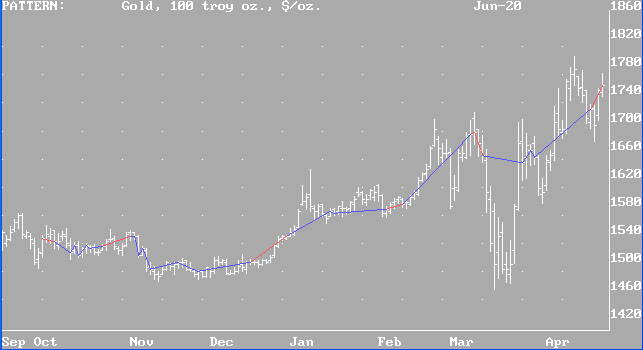
But, as charts indicate, there has been huge move in gold and silver for a very long uptrend with very few weak cycles.
Usually in such cases of extreme moves as we are seeing, the day of reckoning arrives without warning and prices are apt to collapse.
There may be no fundamental reason for this, but once profit-taking starts on a large scale, panic selling could make for extreme moves.
It is much easier to trade in commodities that have reulgar periodic cycles on shorter term bases than to risk going with "the trend is your friend" theory at the peak of such a long runaway sharp uptrend.
We fed Cocoa into a neural network to get the following result:


The way this is supposed to work is the height of the bars indicates confidence level in predictions based upon data fed into a neural network. These bars are very short consistently suggesting a very low confidence level in making any trade. What we see here is no trades completed trades made here starting out long for maximum profit potential, as gold is caught in a straight up long trend where any sales would have generated likely losses. This seems to be a strictly "buy and hold" situation where no previous repeatable sales data would help the system decide upon a sale point. While a crash is extemely likely at some point after metals rally like this, the only recommendation seem to be to maintain tight stops and hope they don't get run by market makers.
We had hoped to do an intermarket analysis, i.e. throw in silver to help establish possible trade points, but time did not allow further meddling with this system which appears rather useless in this situation. In future articles we hope to revive multiple re;ated commodities to integrate into predictions.